Side effects
Mounjaro and Zepbound Side Effects by Dose
Mounjaro and Zepbound side effects from both US labels: nausea, diarrhea and more as percentages at 5, 10 and 15 mg, plus the signs that need a doctor.
Guides
GLP-1 constipation is a listed effect of all four medicines, and each label's trial table reports it more often than placebo. Rates range from 3.1% on Ozempic 1 mg to 24% on Wegovy, in different trials. The labels give no fixed duration, so the practical points are knowing the warning signs and asking your prescriber what suits you. Severe pain, persistent vomiting or no stool or gas are signs to contact a doctor.
In short
- Ozempic's label reports constipation in 5.0% of people at 0.5 mg and 3.1% at 1 mg, against 1.5% on placebo, in type 2 diabetes trials.
- In separate weight-management trials of up to 68 and 72 weeks, Wegovy's label reports 24% against 11% on placebo, and Zepbound's reports 17% at 5 mg against 5%.
- All four labels list ileus and intestinal obstruction after approval. Separately, severe pain, persistent vomiting or no stool or gas are signs to contact a doctor.
Each medicine's prescribing information lists constipation in its adverse reactions table, and every table shows a higher rate than placebo. The table below sets them side by side, with the severe gastrointestinal reaction rate beside it.
| Medicine (indication) | Dose | Constipation | Placebo | Severe GI reactions | Placebo |
|---|---|---|---|---|---|
| Ozempic (type 2 diabetes) | 0.5 mg | 5.0% | 1.5% | 0.4% | 0% |
| Ozempic (type 2 diabetes) | 1 mg | 3.1% | 1.5% | 0.8% | 0% |
| Wegovy (weight management) | 2.4 mg | 24% | 11% | 4.1% | 0.9% |
| Mounjaro (type 2 diabetes) | 5 mg | 6% | 1% | 1.3% | 0.9% |
| Mounjaro (type 2 diabetes) | 10 mg | 6% | 1% | 0.4% | 0.9% |
| Mounjaro (type 2 diabetes) | 15 mg | 7% | 1% | 1.2% | 0.9% |
| Zepbound (weight management) | 5 mg | 17% | 5% | 1.7% | 1% |
| Zepbound (weight management) | 10 mg | 14% | 5% | 2.5% | 1% |
| Zepbound (weight management) | 15 mg | 11% | 5% | 3.1% | 1% |
Sources are the Ozempic, Wegovy, Mounjaro and Zepbound labels. Ozempic and Mounjaro figures come from placebo-controlled type 2 diabetes trials. Mounjaro's pool is SURPASS-1 and SURPASS-5, with mean exposure of 36.6 weeks. Wegovy's trials enrolled adults with obesity or overweight for up to 68 weeks plus a 7-week follow-up. Zepbound's ran up to 72 weeks plus 4 weeks of follow-up.
The severe column covers all severe gastrointestinal reactions, not constipation alone. Because populations, doses and durations differ, the rows show each label's own results and do not rank one medicine above another.
Spain's CIMA data sheet for Ozempic lists constipation as frequent, meaning at least 1 in 100 but fewer than 1 in 10 people.
GLP-1 medicines slow gastric emptying according to their labels, and whether that slowing causes constipation is not established. It is a plausible route, since food then moves through the gut more slowly. Eating and drinking less may add to it, because a smaller intake leaves less bulk and fluid in the bowel. That too is a possible contributor, not a proven cause.
A small case series using a wireless motility capsule found delayed motility in 90% of its patients, which is 9 of 10. That is an objective look at gut transit. It is not a constipation rate, and it is far too small to compare with the label tables above.
What is not known is how much comes from slower transit and how much from lower intake. The label tables count constipation but do not split it by cause.
No. The labels report constipation over whole trials, with a mean exposure of 36.6 weeks in the Mounjaro pool and trials of up to 72 weeks in Zepbound's, and none states a start day, a peak or a typical duration. Those rates describe the whole trial, not a single week.
If you wonder whether a recent dose is still building up, two pages help. One covers how long it takes tirzepatide to reach steady state. Another gives a week-by-week decay table for how long semaglutide stays active. The free half-life calculator gives an estimate of how much medication is still active from your own doses. These explain timing of the medicine. They do not predict your bowels.
If constipation lasts longer than you expected, tell your prescriber.
Not consistently: across the label tables, constipation rates do not climb steadily with dose. Zepbound's label shows 17% at 5 mg, 14% at 10 mg and 11% at 15 mg. Mounjaro's shows 6%, 6% and 7% at 5, 10 and 15 mg. Ozempic's shows 5.0% at 0.5 mg and 3.1% at 1 mg.
Severe gastrointestinal reactions in Zepbound's label do rise with dose, from 1.7% to 2.5% to 3.1%. Mounjaro's do not, at 1.3%, 0.4% and 1.2%.
The labels do not explain the pattern. Nothing here is a reason to change a dose. The prescriber decides.
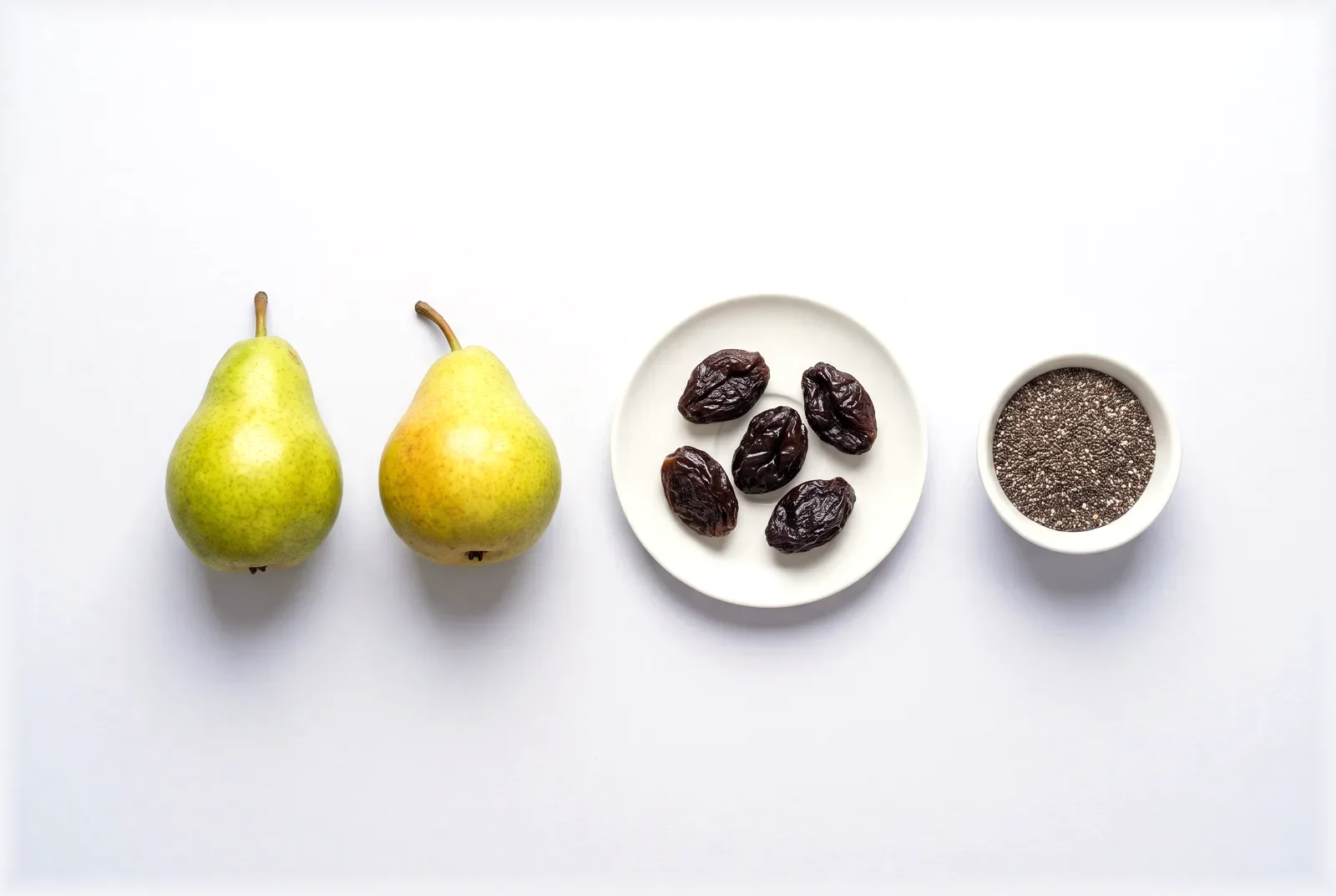
The four labels give no advice for relieving constipation, so the safest step is to ask a prescriber or pharmacist what suits you. For readers choosing foods, USDA FoodData Central publishes fibre values, and the table shows fibre per 100 g, energy per 100 g, and fibre per 100 kcal.
| Food (USDA FoodData Central) | Fibre per 100 g | Energy per 100 g | Fibre per 100 kcal |
|---|---|---|---|
| Dried prunes | 7.10 g | 240 kcal | 3.0 g |
| Chia seeds, dried | 34.4 g | 486 kcal | 7.1 g |
| Raw pears | 3.10 g | 57.0 kcal | 5.4 g |
The last column is derived: prunes 7.10 ÷ 240 × 100 = 3.0 g, chia 34.4 ÷ 486 × 100 = 7.1 g, pears 3.10 ÷ 57.0 × 100 = 5.4 g. These are published food composition values. They are not a personal target and do not show that any food relieves constipation.
The four labels list ileus, intestinal obstruction and severe constipation including fecal impaction as post-marketing reports, and say a frequency cannot be reliably estimated. Contact your prescriber or emergency services promptly for any of these signs:
Do not wait to see whether these settle. Check the Zepbound label or your own medicine's label for the full warnings.
A day-by-day log can show whether constipation tracks with doses, water or food, and that is something to bring to a prescriber. Dose & Lose is a tracking app for iPhone and Android.
In the app, where side effects, water and protein intake can be logged day by day, you rate symptoms from 0 to 10 and see them over time next to your doses. It also tracks fibre and water goals. It does not diagnose or treat constipation, and it gives no dosing advice.
The labels cannot answer that, because the figures come from separate trials. Zepbound's label reports 17% at 5 mg against 5% on placebo over up to 72 weeks. Wegovy's reports 24% against 11% on placebo over up to 68 weeks. Populations and designs differ, so the choice belongs to you and your prescriber.
Ask your prescriber or pharmacist first, because the four labels in this guide give no laxative advice and this guide gives no doses. The right choice depends on your health and other medicines. If constipation comes with severe pain, vomiting, or no stool or gas, seek care instead of treating it alone.
Constipation does not by itself mean ileus, but the labels list both. All four labels list ileus, intestinal obstruction and severe constipation with fecal impaction as post-marketing reports with no estimable frequency. Severe abdominal pain, vomiting, or no stool or gas are the signs to act on, so contact a doctor promptly.
The labels do not answer that directly. They report constipation over whole trials, not at each dose step, and the rates by dose group did not rise steadily. If it returns or worsens after a change, tell your prescriber, who decides about the dose.
Published by Petros IT Solutions SRL, byline Dose & Lose Editorial Team. Corrections: office@doseandlose.com.