Doses and medication level
How Long Does Mounjaro Take to Work?
How long does Mounjaro take to work? Steady state is about 4 weeks per dose; see the label and SURMOUNT-1 weight change by dose.
Guides
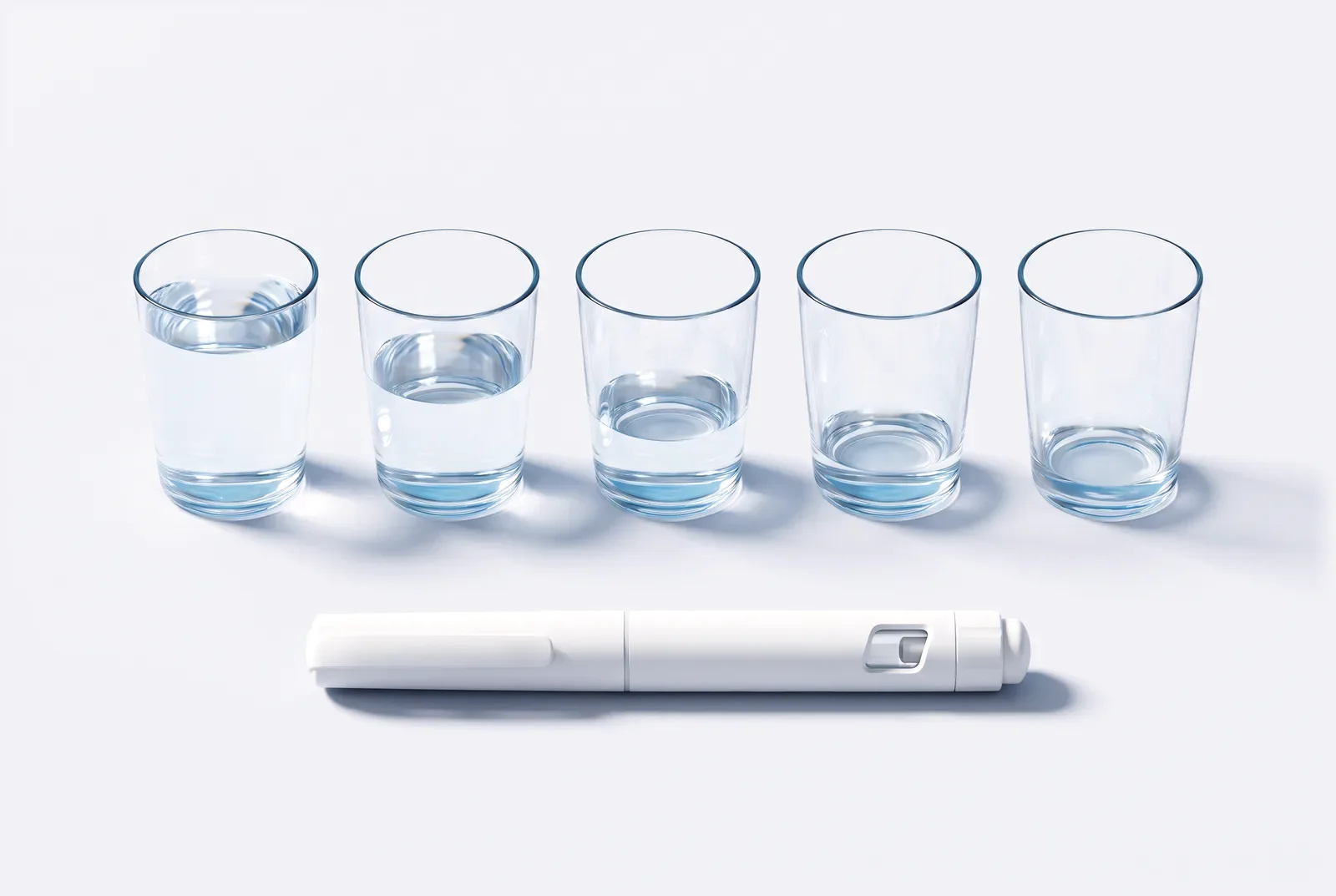
How long does Ozempic stay in your system? Semaglutide stays in the circulation for about 5 weeks after the last dose. The Ozempic prescribing information says that with an elimination half-life of approximately 1 week, semaglutide will be present in the circulation for about 5 weeks after the last dose.
The sections below show the arithmetic week by week, so you can redo it yourself. These are general label facts. Decisions about your own doses belong to you and your prescriber.
In short
- The Ozempic label gives an elimination half-life of approximately 1 week for semaglutide.
- The same label says semaglutide is present in the circulation for about 5 weeks after the last dose.
- The label advises discontinuing Ozempic in women at least 2 months before a planned pregnancy because of the long washout period.
The Ozempic US prescribing information, section 12.3, states that semaglutide will be present in the circulation for about 5 weeks after the last dose. That sentence is the label's own answer.
"Present" does not mean "at full strength". With a half-life of about a week, the amount halves each week. The table further down shows how.
The Spanish and EU product sheet from AEMPS gives the same half-life of approximately 1 week in its overdose section, so the figure is not specific to one market.
The Ozempic label gives semaglutide an elimination half-life of approximately 1 week, which means the amount in the body roughly halves every 7 days.
The label's clinical pharmacology section (12.1) describes the mechanism. Semaglutide binds to albumin, a protein in the blood. That binding reduces clearance by the kidneys and protects the molecule from metabolic breakdown. Semaglutide is also stabilized against degradation by the DPP-4 enzyme.
After the last dose, each week's half-life step leaves half of the previous amount, so five weeks leaves about one thirty-second. The label states the 1-week half-life and the 5-week figure. The rest is arithmetic.
The amounts below are illustrative arithmetic, not measured values. They start from the three maintenance doses on the label (0.5 mg, 1 mg and 2 mg once weekly, section 2.2) and treat each as the amount present at the last dose. Real levels also depend on absorption and on earlier weekly doses, which this simple table ignores.
| Weeks after last dose | Share left | Starting at 0.5 mg (illustrative) | Starting at 1 mg (illustrative) | Starting at 2 mg (illustrative) |
|---|---|---|---|---|
| 0 | 1 | 0.500 mg | 1.000 mg | 2.000 mg |
| 1 | 1/2 (50%) | 0.250 mg | 0.500 mg | 1.000 mg |
| 2 | 1/4 (25%) | 0.125 mg | 0.250 mg | 0.500 mg |
| 3 | 1/8 (12.5%) | 0.063 mg | 0.125 mg | 0.250 mg |
| 4 | 1/16 (6.3%) | 0.031 mg | 0.063 mg | 0.125 mg |
| 5 | 1/32 (3.1%) | 0.016 mg | 0.031 mg | 0.063 mg |
To redo a row, halve the row above it. For 1 mg: 1 → 0.5 → 0.25 → 0.125 → 0.0625 → 0.03125. After five halvings, about 3% remains, which fits the label's "about 5 weeks".
The label gives one half-life for all maintenance doses, and no separate clearance time for each. The table shows only that a larger starting amount takes one extra halving to reach a given small amount. Starting at 2 mg, you reach 0.5 mg after two weeks. That is the arithmetic of halving, not a measured difference.
To see your own logged doses modeled, use the Ozempic half-life calculator, which estimates semaglutide left in the body from the label's half-life.
The Ozempic label gives no day count for how long side effects last after the last dose. It does state that semaglutide is present for about 5 weeks, so the medicine itself leaves gradually, not on one day.
Our guide to how long Ozempic nausea lasts and its warning signs covers the label's nausea rates and what to watch for.
Contact your prescriber if a symptom is severe, keeps getting worse or worries you. Seek emergency care for severe stomach pain, vomiting that will not stop, or signs of a serious allergic reaction such as swelling of the face or trouble breathing.
Section 8.3 of the Ozempic US label says: "Discontinue OZEMPIC in women at least 2 months before a planned pregnancy due to the long washout period for semaglutide." We quote it as the label gives it.
The Spanish product sheet from AEMPS (section 4.6) says the same in its own words: treatment should be stopped at least 2 months before a planned pregnancy.
The label gives the reason as the long washout period for semaglutide. Whether and when to stop is a decision for you and your prescriber.
The Ozempic label describes no way to speed clearance. It attributes the long half-life mainly to albumin binding (section 12.1).
If you are asking because of a symptom, a procedure or a pregnancy plan, the useful step is to tell your prescriber or care team, who can advise for your situation.
These are the habits that quietly turn a clear label figure into a wrong conclusion.
The Dose & Lose app can help you keep track of doses and see an estimate of the medication level. You log each dose, and the app draws an estimate over 7, 30 or 90 days from your logged doses. You can also rate side effects day by day and see them next to your doses.
The estimate comes from a fixed model, not a lab test. The app does not measure anything in your body and does not give dosing advice. Its model half-life for semaglutide is a little shorter than the label's "approximately 1 week", so use the label for the drug's half-life. See the Dose & Lose app, where logged doses feed the medication level estimate.
Storage questions come up too, so see our guide to Ozempic storage, including after the last dose. For a comparison with another medicine, there is a guide to how long Mounjaro takes to work.
Wegovy contains the same active ingredient, semaglutide, but the figures in this article come from the Ozempic label. For Wegovy, check its own prescribing information or ask your prescriber. The Wegovy half-life calculator models Wegovy shots using that label's half-life.
The Ozempic label (section 5.10) says to tell your healthcare providers before any planned surgery or procedure if you take Ozempic. It gives no stopping time. Your surgical and anesthesia team sets instructions for your case, so tell them you use Ozempic and when your last dose was.
Contact your prescriber about any symptom that is severe, keeps worsening or worries you. Seek emergency care for severe stomach pain, vomiting that will not stop, or signs of a serious allergic reaction, such as swelling of the face or trouble breathing. The label lists its own warnings in full.
Published by Petros IT Solutions SRL, byline Dose & Lose Editorial Team. Corrections: office@doseandlose.com.