Comparing GLP-1 medicines
Does the Wegovy Pill Work? Tablet vs Shot
Does the Wegovy pill work? See the injection's STEP 1 and the tablet's OASIS 4 results side by side, with population, dose, duration and dosing rules.
Guides
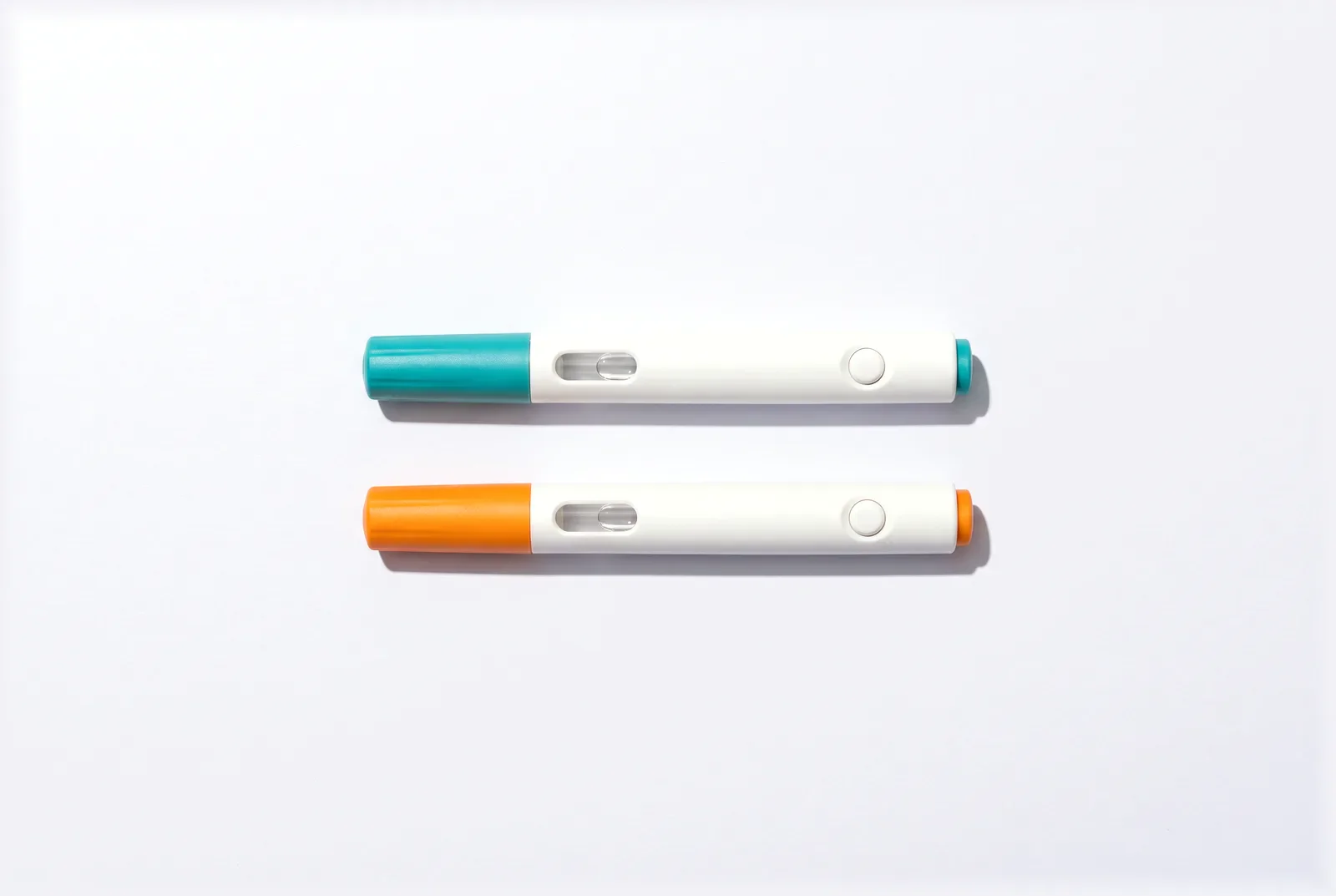
Wegovy vs Ozempic comes down to the label, not the molecule. Both contain semaglutide from Novo Nordisk. The US Ozempic label covers type 2 diabetes, with a top dose of 2 mg weekly, while the Wegovy label covers weight management, with 2.4 mg as the recommended maintenance dose.
Which one fits a person is a decision for that person and their prescriber, and this article reports the labels without ranking them. Every figure below comes from the US prescribing information on DailyMed or from a published trial, with its population named.
In short
- The US labels set different top doses: 2 mg weekly for Ozempic and a recommended 2.4 mg for Wegovy, according to DailyMed.
- Label nausea rates are 15.8% to 20.3% for Ozempic in type 2 diabetes and 44% for Wegovy in weight management, from different populations.
- STEP 1 reported a 14.9% average fall in body weight at 2.4 mg over 68 weeks in adults with obesity or overweight (NEJM 2021), separate from SUSTAIN 1.
The US prescribing information on DailyMed shows Ozempic and Wegovy sharing one active ingredient, semaglutide, with different indications, dose steps and trial results. The table sets the Ozempic label beside the Wegovy label. The trial rows come from two separate studies.
| Ozempic (US label) | Wegovy injection (US label) | |
|---|---|---|
| Active ingredient | Semaglutide | Semaglutide |
| Approved for | Type 2 diabetes: glycemic control, cardiovascular and kidney risk reduction | Weight reduction and maintenance in obesity, or overweight with a related condition; cardiovascular risk reduction; MASH with fibrosis |
| How often | Once weekly | Once weekly |
| Label dose steps | 0.25 mg for 4 weeks (not a treatment dose), 0.5 mg, then 1 mg and 2 mg after at least 4 weeks each | 0.25, 0.5, 1 and 1.7 mg for 4 weeks each, then 1.7 or 2.4 mg |
| Top dose | 2 mg | 2.4 mg recommended; 7.2 mg for selected patients |
| Nausea | 15.8% (0.5 mg) and 20.3% (1 mg) vs 6.1% placebo | 44% (2.4 mg) vs 16% placebo |
| Trial result | SUSTAIN 1, type 2 diabetes, 30 weeks, n=388: 3.7 kg lost (0.5 mg), 4.5 kg (1 mg), 1.0 kg placebo | STEP 1, obesity or overweight, 68 weeks, n=1,961: 14.9% lost at 2.4 mg, 2.4% placebo |
Approval differs by country. The AEMPS ficha técnica for Ozempic in Spain lists pens up to 2 mg, which matches the US label's maximum. Doses and strengths for Wegovy can also differ by country, so check the label that applies where you live. SUSTAIN 1 reports kilograms and STEP 1 reports a percentage, so the two results cannot be read against each other directly.
Wegovy and Ozempic contain the same drug, semaglutide, from the same manufacturer, but they are separate products with separate labels. The EMA's Ozempic assessment names semaglutide, a GLP-1 receptor agonist made by Novo Nordisk, as Ozempic's active ingredient. The Wegovy label on DailyMed lists the same manufacturer.
The Ozempic label lists three uses, all in type 2 diabetes. These are glycemic control alongside diet and exercise, fewer major cardiovascular events in people with established cardiovascular disease, and slower kidney decline with fewer cardiovascular deaths in people with chronic kidney disease.
The Wegovy label lists weight reduction and maintenance alongside a reduced-calorie diet and more physical activity. That covers adults and adolescents 12 and older with obesity, and adults with overweight plus a weight-related condition. It also lists lower cardiovascular risk in adults with established cardiovascular disease and obesity or overweight, and noncirrhotic MASH with moderate to advanced liver fibrosis (accelerated approval).
A label states what a medicine was tested and approved for. Which indication applies to a person is for the prescriber to judge.
The US labels give Ozempic a maximum of 2 mg once weekly and Wegovy a recommended maintenance dose of 2.4 mg once weekly, with a 7.2 mg option. Both are once-weekly injections, so the rhythm is the same while the steps differ.
The Ozempic label starts at 0.25 mg weekly for 4 weeks, which it says is not a treatment dose, then moves to 0.5 mg. It allows 1 mg and then 2 mg if more glycemic control is needed, after at least 4 weeks on the prior dose.
The Wegovy label steps from 0.25 mg (weeks 1 to 4) to 0.5 mg (weeks 5 to 8), 1 mg (weeks 9 to 12) and 1.7 mg (weeks 13 to 16). Maintenance is then 1.7 mg or the recommended 2.4 mg. The 7.2 mg dose is only for patients who have tolerated 2.4 mg for at least 4 weeks and need additional weight reduction. The Wegovy dose chart shows these label steps as a chart.
These are quotations from the labels, not a schedule to follow. The prescriber decides the dose and any change.
The Wegovy pill is not the same product as Ozempic: the Wegovy label describes it as a daily tablet, while Ozempic is a once-weekly injection. Its dosing sits in Section 2.3 of the Wegovy label on DailyMed.
The label starts at 1.5 mg daily on days 1 to 30, then 4 mg on days 31 to 60 and 9 mg on days 61 to 90. From day 91 the maintenance and maximum dose is 25 mg once daily.
Those milligram figures belong to the tablet's own scale. A number from the pill label should not be read against an Ozempic or Wegovy injection dose, because each label sets its own steps for its own form.
Dose & Lose lists the Wegovy pill as its own medication, separate from Wegovy and Ozempic injections. The prescriber decides which form, if any, suits a person.
Both labels list nausea, vomiting, diarrhea and constipation among their reported reactions, but the rates come from different trials and are not like for like. The table uses Section 6.1 of each label.
| Reaction | Ozempic 0.5 mg (N=260) | Ozempic 1 mg (N=261) | Ozempic placebo (N=262) | Wegovy 2.4 mg (N=2,116) | Wegovy placebo (N=1,261) |
|---|---|---|---|---|---|
| Nausea | 15.8% | 20.3% | 6.1% | 44% | 16% |
| Vomiting | 5% | 9.2% | 2.3% | 24% | 6% |
| Diarrhea | 8.5% | 8.8% | 1.9% | 30% | 16% |
| Constipation | 5% | 3.1% | 1.5% | 24% | 11% |
The Ozempic columns come from placebo-controlled trials in adults with type 2 diabetes and do not include the 2 mg dose. The Wegovy columns come from a weight-management population. Placebo rates differ too, for example nausea at 6.1% against 16%, which suggests the groups and designs are not alike. For context on meals around nausea, see the guide on what to eat on Ozempic shot day.
The labels carry warnings beyond these common reactions. Seek urgent care for severe stomach pain that does not go away, repeated vomiting or diarrhea with signs of dehydration, an allergic reaction, or a lump in the neck, hoarseness or trouble swallowing. Tell the prescriber about any symptom that worries you.
Novo Nordisk's SUSTAIN programme tested semaglutide in type 2 diabetes, and its STEP programme tested 2.4 mg in people with obesity or overweight. Neither result below is from a head-to-head trial.
SUSTAIN 1 (Sorli et al., Lancet Diabetes & Endocrinology, 2017) enrolled 388 adults with type 2 diabetes managed by diet and exercise alone. Over 30 weeks, semaglutide 0.5 mg lost 3.7 kg and 1.0 mg lost 4.5 kg, against 1.0 kg with placebo. Baseline weight was about 91.9 kg. HbA1c fell 1.5% and 1.6%, against less than 0.1% with placebo.
STEP 1 (Wilding et al., NEJM, 2021) enrolled 1,961 adults with obesity or overweight: 1,306 on semaglutide 2.4 mg and 655 on placebo. After 68 weeks, mean body weight changed by 14.9% with semaglutide and 2.4% with placebo (p<0.001).
To put SUSTAIN 1 in percentages, divide by the baseline: 3.7 ÷ 91.9 is about 4.0%, and 4.5 ÷ 91.9 is about 4.9%. The populations, doses and durations still differ. The weight-loss percentage calculator works out a percentage change between two weights and shows STEP 1's average beside it. Trial averages describe the group studied, not a personal result.
Semaglutide is the active ingredient, and Ozempic is one brand name for a product that contains it, according to the EMA's Ozempic page. Wegovy is a second brand containing the same ingredient, according to its DailyMed label.
The label evidence points to a simple reason for two names. Each product was approved for its own indication, with its own dose range and trial programme. Ozempic's labelled steps end at 2 mg for type 2 diabetes, while Wegovy's reach 2.4 mg, with a 7.2 mg option, for weight management. That is the article's reading of the labels, not a statement from the manufacturer.
Brand names and approvals also vary by country, so check the label that applies where you live.
To see what a schedule may leave in the body, you can estimate semaglutide from an Ozempic schedule or from a Wegovy schedule up to 2.4 mg or 7.2 mg. The guide on how long Ozempic stays in your system adds a week-by-week decay table.
Dose & Lose supports Ozempic, Wegovy and the Wegovy pill, so a person on either brand can log it in the same way.
Each dose is logged with the medication, dose, date and time, injection site, a pain level from 0 to 10 and notes. Side effects such as nausea are rated from 0 to 10 day by day and shown over time next to the doses. The app also draws an estimate of the medication level from logged doses. It is an estimate, not a lab value.
The app does not prescribe or give dosing advice. Here is where the app is described.
That decision belongs to the prescriber. The US Ozempic label lists type 2 diabetes uses, while the Wegovy label lists weight reduction and maintenance. A prescriber weighs the labelled indications, the person's health and local rules. This article cannot say which choice fits an individual.
They are separate products, each with its own pens. The US Ozempic label lists pens delivering 0.25 or 0.5 mg, 1 mg or 2 mg, and pen strengths differ by product, label and country. Check the dosage-forms section of the label that applies, and use the instructions that come with the prescribed pen.
The labels cannot answer that directly, because their rates come from different trials. Nausea was 44% on Wegovy 2.4 mg against 16% on placebo in weight management, and 15.8% to 20.3% on Ozempic against 6.1% in type 2 diabetes. Population and design differ, not only dose.
Switching is a prescriber decision, and this article cannot advise on it. Each label sets its own starting steps, and the prescriber sets any new dose and schedule. Do not change or stop a medicine without that conversation, and tell the prescriber about side effects first.
Published by Petros IT Solutions SRL under the byline Dose & Lose Editorial Team. Send corrections to office@doseandlose.com.